Saturday, July 10, 2010

The Enchanted Playhouse

"Some day you will be old enough to start reading fairy tales again." ~ CS Lewis~


"It was the visit to Cousin Alice that began it, for Cousin Alice's little 'Lizbeth Ann, who was just about as big as Patty and Polly, had a playhouse - the loveliest little playhouse!

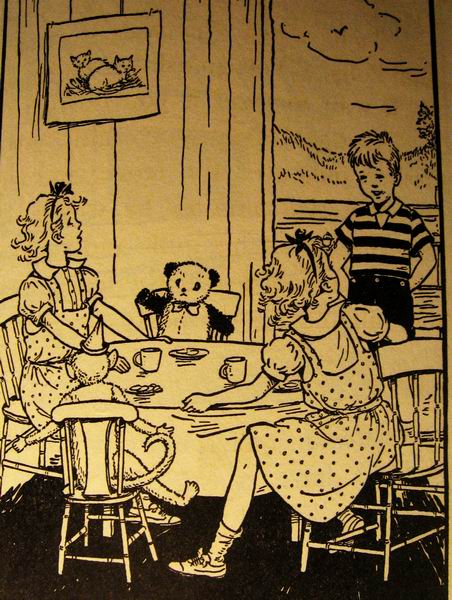
"It had a porch on the front, and a path leading to the door. There was a row of bright red geraniums at either side of the path, and 'Lizbeth Ann had even put an even row of cockleshells right in front of the red geraniums, for all the world like Mistress Mary's garden!"
"From that day Patty and Polly could think of nothing but a playhouse. They talked and talked about it.

"The tent made quite a nice playhouse, but not as nice as the Pigpen House, and neither one was half as nice as 'Lizbeth Ann's."

"While they nibbled seedcakes and drank cambric tea, they told Miss Merriweather all about 'Lizbeth Ann's playhouse and how they had tried to have one too. "I remember one I had when I was little," said Miss Merriweather. "My brothers made it for me, up in an apple tree."


"Come, come you youngsters, I've thought of something," said Cap'n Holly. "How'd you like a house under that old dory back there? It's way above high-water mark. I'll tip it over, then we can brace it up with logs on end, so you can crawl underneath." Then he told them all about Mr. Peggotty's house, made out of a boat, in a book written by a man named Charles Dickens. Patty, Polly and Alec listened eagerly and couldn't wait to have a house like Mr. Peggotty's."

"Then tomorrow came, and the wind blew, and there was an awful storm.

"Was it a hurricane Daddy?" they asked. "Yes it was." Daddy said.


"Everything was sopping wet, but Patty, Polly and Alec had to go and see it all. On they went, through the long wet grass, and there, right on their own field, stood the most enchanting little playhouse. It was tipped to one side, and its windows were broken, but it was still an enchanted playhouse. They looked in through the broken windows, and there, all piled up in one corner, and soaking wet, were little tables and chairs, and a little bureau too.


"That very day Joe started repairing the little house. He put in strong cement underpinnings; he put new glass in the windows, fresh paper on the walls, and painted inside and out. Mother made pretty flowered curtains for the windows and bought a gay new rug for the floor.


"It was such a lovely little playhouse! "It's almost too good to be true," sighed Polly happily. "Yes but it is true," said Patty. "We have a real playhouse at last!"


The Enchanted Playhouse, by Mabel Betsy Hill, First and Only Edition, 1950. Offered for sale by Chewybooks, as of July 10, 2010.

Thursday, July 8, 2010

The kings sleep in the ground

Ind raith i comair in dairfhedo,
Ba Bruidgi, ba Cathail,
Ba Aedo, ba Aillello,
Ba Conaing. ba Cuilini,
Ocus ba Maile Duin:
Ind raith dar eis caich ar uair,
ocus ind rig foait i n-uir.

The fort over against the oakwood,

It was Bruidge's, it was Cahill's,

It was Aed's, it was Aillil's,

It was Conaing's, it was Cuiline's,

It was Mael Duin's:

The fort remains after each in turn,

And the kings sleep in the ground.

"And so it was first told of to a mortal, this crown that was in the well, and if it had not been told about, this crown of Bruin, the war that the rest of Ireland waged against Cncobar's kingdom, the war for the Brown Bull of Cooley, would not have been.

"For when Nera went back to the world of mortals he told the King and Queen of Connacht, Ailill and Maeve, about the treasure in the well. They broke into the Fairy Mound of Cruachan to possess themselves of the crown of Bruin. Some say the treasure was taken by them and some say they could neither reach or nor take it, but the storytellers of Ireland have to speak about it because the foray brought the Battle Goddess Morrigu into the Fairy Mound of Cruachan.

The Frenzied Prince Being Heroic Stories of Ancient Ireland, Told by Padraic Colum, Illustrated by Willy Pogany, 1943, Stated First Edition, embossed green cloth with gold gilt titling, illustrated endpapers,color plates throughout, includes original dust jacket. Retained for personal collection.


Sunday, July 4, 2010

Freedom is the right to tell people what they do not want to hear


All the war-propaganda, all the screaming and lies and hatred, comes invariably from people who are not fighting.


Every war when it comes, or before it comes, is represented not as a war but as an act of self-defense against a homicidal maniac.


Mankind is not likely to salvage civilization unless he can evolve a system of good and evil which is independent of heaven and hell.


People sleep peaceably in their beds at night only because rough men stand ready to do violence on their behalf.


Political chaos is connected with the decay of language.


The atom bombs are piling up in the factories, the police are prowling through the cities, the lies are streaming from the loudspeakers, but the earth is still going round the sun.


War against a foreign country only happens when the moneyed classes think they are going to profit from it.


We of the sinking middle class may sink without further struggles into the working class where we belong, and probably when we get there it will not be so dreadful as we feared, for, after all, we have nothing to lose.


What can you do against the lunatic who is more intelligent than yourself, who gives your arguments a fair hearing and then simply persists in his lunacy?


Who controls the past controls the future. Who controls the present controls the past.


The very concept of objective truth is fading out of the world. Lies will pass into history.


During times of universal deceit, telling the truth becomes a revolutionary act.

George Orwell (June 25, 1903- January 21, 1950)

Sunday, June 27, 2010

A Death In Belmont

A picture is worth a thousand words. And sometimes, a picture is as easily misunderstood as a thousand words.

Here's a lovely multigenerational family photo: young mother beaming down at her toddler on her lap, the proud handsome father standing behind her, both watched lovingly by a grandfather? Favorite uncle maybe?

Hmm. Images are not always what they appear to be.

The older man is actually a carpenter -one who built the house the young woman lives in. He and his assistant have spent the better part of the last two months building an studio addition to the young woman's home - going in and out at all hours, generally unsupervised, while her husband is away at work.

The young woman is an artist, and the child on her lap is most definitely loved and cherished.

That child will grow up to be an accomplished author, one with no memory of the day this photo was taken.

And the proud young father? That handsome young man is actually a part-time laborer, the assistant to the carpenter. He is strong and muscular, quiet and polite, conscientious about his work -always arriving on time and always particular about details.

His name is Al.

Albert DeSalvo. And he is about to become better known as The Boston Strangler.


A Death in Belmont is the strange story of author Sebastian Junger's brush with the infamous. It's the story of the day his mother hired a carpenter to build an addition to her home, and found herself staring down her basement steps, into the eyes of a man that would turn out to be a serial killer. That particular day, Albert DeSalvo had murdered a woman several blocks away, and then reliably showed up for work. When called to the top of the basement steps, something about his eyes served as warning, and the young mother stepped back, shut the door, and threw the bolt. In hindsight, entire lives turned on that one little uneasy feeling, that one small thought, that one glimmer of premonition.

This is one of those books you can't put down.

A Death in Belmont, by Sebastian Junger (2006).

Wednesday, June 16, 2010

Crazy Horse and Custer

"On the sparkly morning of June 25, 1876, 611 men of the United States 7th Cavalry rode towards the banks of the Little Bighorn in the Montana Territory where three thousand Indians stood waiting for battle. The lives of two great warriors would soon be forever linked in history.

"This is the story of two men who died as they lived - violently. They were both war lovers, men of aggression with a deeply rooted instinct to charge the enemy, rout him, kill him. Men of supreme courage, they were natural-born leaders in a combat crisis, the type to whom others instinctively looked for guidance and inspiration. They were always the first to charge the enemy, and the last to retreat. Both became leaders in their societies at very early ages; both were stripped of power, in disgrace, and worked to earn back the respect of their people. Both had much to win and only life to lose.

"There were other parallels. Neither man drank. Both were avid hunters, for whom only the excitement of combat exceeded the joy of the chase. Each man loved horses, and riding at full gallop across the unfenced Great Plains of North America, day after day, was a source of never-ending delight for both of them.

"Yet Crazy Horse and Custer, like their societies, were as different as life and death."

Crazy Horse and Custer, by Stephen Ambrose (1975 BCE with dj). Offered for sale by Chewybooks as of June 16, 2010.


Monday, June 14, 2010

A Moveable Feast: Sketches of Paris in The Twenties

"You got very hungry when you did not eat enough in Paris because all the bakery shops had such good things in the windows and people sat outside at tables on the sidewalk so that you saw and smelled the food. When you had given up journalism and were writing nothing that anyone in America would buy, explaining at home that you were lunching out with someone, the best place to go was the Luxembourg gardens where you saw and smelled nothing to eat all the way from the Place de l'Observatoire to the rue de Vaugirard.

"There you could always go into the Luxembourg museum and all the paintings were sharpened and clearer and more beautiful if you were belly-empty, hollow-hungry. I learned to understand Cezanne much better and to see truly how he made landscapes when he was hungry.

"I used to wonder if he were hungry too when he painted; but I thought possibly it was only that he had forgotten to eat. It was one of those unsound but illuminating thoughts you have when you have been sleepless or hungry.

"Later I thought Cezanne was probably hungry in a different way."

A Moveable Feast:Sketches of the Author's Life in Paris in The Twenties (Ernest Hemingway), First Edition, BMC (1964). Offered for sale by Chewybooks, as of June 14, 2010.

Saturday, June 12, 2010

Fly Boys

Wartime is the mothership of invention. So many words and phrases were created by soldiers and sailors during World War II; figures of speech that we've long since forgotten the origin of (not just the immortal FUBAR) but more obscure "slanguage", such as....


Tin fish (an aerial torpedo), flak (Abbreviation of "Fleiger abwehr Kanone", a German phrase meaning anti-aircraft cannon fire), grease monkey (any member of a aircraft ground crew), lame duck (a crippled airplane) and....

V-Mail (Mail for World War II military, where the original was written on a specially printed form, then photographed on 16mm microfilm, sent to its destination by air, where it was enlarged and delivered to its recipient. V-Mail forms were available at any post office, and could be dropped into any mail box. 200,000 microfilm letters fit into one mailbag.


In 1942, it was also necessary for pilots to know how to dock and pilot airships, a skill now sadly lost.


There were several sorts of airships: non-rigid, pressure-rigid, rigid, and semi- rigid. There were airship stations, airship hulls, airship gangplanks, airship cabins, bumper bags, an aerostat center of buoyancy, bridles, axial cables, and bow-weighing devices. All of those long-lost definitions are described and illustrated in exquisite detail, straight from 1942 and those who lived it.


Jordanoff's Illustrated Aviation Dictionary, (1942). Offered for sale by Chewybooks, as of June 12, 2010.